An AI cofounder is an AI partner that researches, plans, and builds a product with you. It carries full context on the project across sessions, brings broad knowledge a human cofounder can't, and challenges your thinking when it sees issues. This page covers where the term came from, what an AI cofounder actually does, what it doesn't, and how the role compares to a human cofounder.
What is an AI cofounder?
 David Heikka•7 min read
Table of contents
Definition
An AI cofounder is the role an AI plays when it works on a product with a founder the way a human cofounder would. It carries the full context of the project across every session, contributes to decisions, takes positions of its own, and does the work together with the founder. The word cofounder fits because the relationship is built around shared work and shared thinking over the life of the project.
This is different from how an AI assistant works. An assistant is general-purpose, starts fresh each conversation, executes what the user asks, and has no opinion of its own. An AI cofounder works the opposite way. It specializes in your project, remembers every conversation and decision, has its own view on what should happen next, and proactively moves the work forward.
It's also different from how an AI agent works. An agent is given a goal and runs autonomously to complete it, often without the human involved until it's done. An AI cofounder works inside the loop with the founder throughout. It thinks problems through together with the founder, moves the project forward in small visible steps, and pauses whenever something needs the founder's input. This way the founder stays close to every decision and builds real understanding of the project as it takes shape.
Where the term came from
The term wasn't ours. We launched in late September 2024 under a different name, Buildpad. In the weeks that followed, we ran a lot of user calls to learn what was working and what wasn't, and the same description kept coming up: people said the product felt like an AI cofounder. They were describing the experience of having the AI contribute to their thinking, make decisions with them, and do the work with them throughout the project.
We started using the term ourselves soon after. It was a more honest fit than anything we had written in our marketing. The AI carried memory of the project, challenged users on their thinking, and worked together with them on the canvas. Those are the kinds of contributions that make someone a cofounder.
A year later, in October 2025, we bought aicofounder.com. The domain was expensive, but we wanted to commit to the term: not just a product that happened to behave like an AI cofounder, but the ai cofounder.
What an AI cofounder does
The work an AI cofounder does is the same work an early-stage founder does: figuring out what to build, deciding how, doing the research, building it, and reaching the people who will use it. The difference is in who handles each part. The AI cofounder takes some of that work on by itself, does other parts collaboratively with the founder, and prepares the founder for the parts in the real world that only they can do.
Finding an idea. Even without a specific idea, a founder has years of pains, anomalies, and dismissed observations from their own life to draw from. An AI cofounder excavates this material by asking the right questions and grounding what surfaces in real evidence. If a founder mentions an annoyance, it searches Reddit to see whether others are complaining about the same thing, and brings real posts back into the conversation so the founder can see whether the problem is widely felt.
Building a roadmap. Once an idea exists, the work in front of the founder is rarely obvious. An AI cofounder maps out the phases between today and the goal: research that needs to happen, decisions that need to be made, things that need to be built, and real-world actions that need to be taken. It orders them by what depends on what and what risks need to be retired first, then works through the roadmap together with the founder one phase at a time.
Doing the research. Markets, competitors, regulations, customer behavior, pricing, sourcing. Most of what a founder needs to know across these areas takes real time to gather. An AI cofounder runs parallel research agents that go through the web and social media in minutes and produce cited reports the founder can verify.
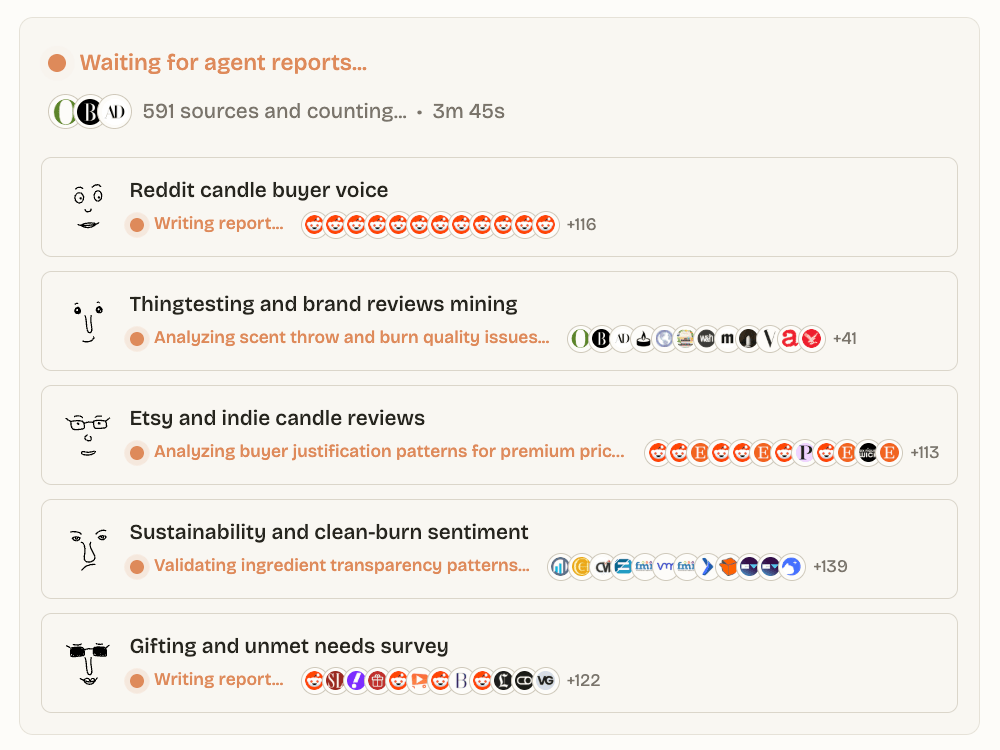
Building things. Websites, landing pages, content, documents, roadmaps. The AI cofounder drafts and revises these as the founder reviews, redirects, and decides what to ship.
Preparing for the work only the founder can do. Calls, emails, contracts, customer conversations. For these, the AI cofounder drafts the messages, finds the contacts, and thinks through what's likely to come back, so the founder is prepared when they take the action. Once the response comes back, they work through it together and decide what to do next.
What an AI cofounder doesn't do
There are parts of building a company an AI cofounder can't do for you. It can't sit across from an investor, shake a customer's hand, sign a contract, or be the human at the end of a hiring decision. The work that requires being a person in a room with another person stays with the founder.
That doesn't mean the AI cofounder steps out of the room. For the work it can't do directly, it helps with everything around it. Before an investor meeting, it researches the firm, summarizes their portfolio, drafts the questions they're likely to ask. Before a customer call, it pulls together what you know about the customer, frames the conversation, drafts the follow-up. Before a hire, it helps you think through what the role really needs and what the wrong fit would cost.
The preparation before an action and the follow-up after it remain shared work. When the founder takes the action itself, the AI cofounder waits in the project and picks back up with them when they return.
AI cofounder vs human cofounder
A human cofounder and an AI cofounder are different things. Each brings something the other can't, and the choice between them isn't really binary. Most teams that think about it carefully end up using both.
A human cofounder brings things tied to being a person who has chosen to bind themselves to the project. They bring equity and aligned long-term incentives, lived experience built over years, personal relationships and a reputation that travel into the project, and shared history that builds trust over time. They can also act in the world as a cofounder: signing legal documents, taking meetings, being physically present where the project needs a person.
An AI cofounder brings things a human can't reliably bring at all. It carries the full context of the project across every session without forgetting anything. It runs research across markets, competitors, regulations, and customer behavior in minutes instead of weeks. It has wide general knowledge across domains a single person rarely covers. And it pushes back on the founder's thinking without softening the feedback to preserve a relationship, because there's no relationship being protected.
When founders compare the two, the practical answer is usually that neither is a substitute. Solo founders use an AI cofounder to fill the partner slot, getting a thinking partner and a working partner without needing to find one. Teams with human cofounders use an AI cofounder for the work that scales differently: the research, the drafting, the context-keeping, the critical voice that stays consistent across the project.
Author: David Heikka