
Why a dedicated planning agent
During a conversation, your AI cofounder is focused on the immediate task: answering your question, working through a problem, executing the current step. That’s exactly what you want most of the time. But strategic planning requires something different. It requires stepping back from the day-to-day and looking at the full picture with fresh eyes. That’s why ultraplan is a separate agent. When it’s time to plan, your AI cofounder hands off to the ultraplan agent with two things: the full contents of your canvas (every document, every note, every piece of research) and context about why planning is needed right now, including any recent decisions or concerns from your conversation. The ultraplan agent has no conversation history to anchor to. It sees only what exists on the canvas and the context it was given. This is intentional. It means the agent can assess the project honestly, without being influenced by the flow of a conversation or anchored to what was discussed most recently. It takes a step back, considers everything, and thinks deeply about where the project actually stands and what should happen next.Constraint-focused thinking
Most planning tries to map out the entire journey from idea to launch. The problem is that detailed plans for later stages are almost always wrong, because the situation changes as you learn more. Ultraplan is built on a different insight: at any point in a project, exactly one constraint limits progress more than all others. Working on anything else before addressing that constraint is wasted effort. A clothing brand can’t optimize their store conversion if they haven’t validated their designs. A software product can’t build distribution if the core user problem isn’t clear. So instead of planning everything, ultraplan focuses entirely on finding that one constraint and creating a plan to break it. The current phase gets detailed, actionable tasks. Future phases get directional sketches that will be revisited once the constraint shifts. This keeps planning honest and grounded in what’s actually true right now, rather than what you hope will be true later.How it works
When your AI cofounder calls the ultraplan agent, it works through a structured assessment:- Assess the current state. What actually exists? What’s been validated through research or real-world evidence? What’s still an assumption? Ultraplan is direct about the difference between what’s known and what’s hoped for.
- Identify the constraint. Not just what feels like the biggest problem, but what’s actually blocking progress. It works through diagnostic questions: What would need to be true for this project to succeed? Which assumption has the least evidence? Which, if wrong, makes everything else irrelevant? Is this the root cause, or a symptom of something deeper?
- Plan the current phase. A detailed plan with a clear objective, specific tasks, completion criteria, and risks. Each task specifies what needs to be done, what it produces, and how it contributes to breaking the constraint. Tasks are designed to be worked through one at a time, sequentially, so findings from each step can inform what comes next.
- Sketch future phases. One or two sentences about what likely comes next, without detailed planning. These sketches are for directional awareness only. They will change once the current constraint is broken and a new one emerges.
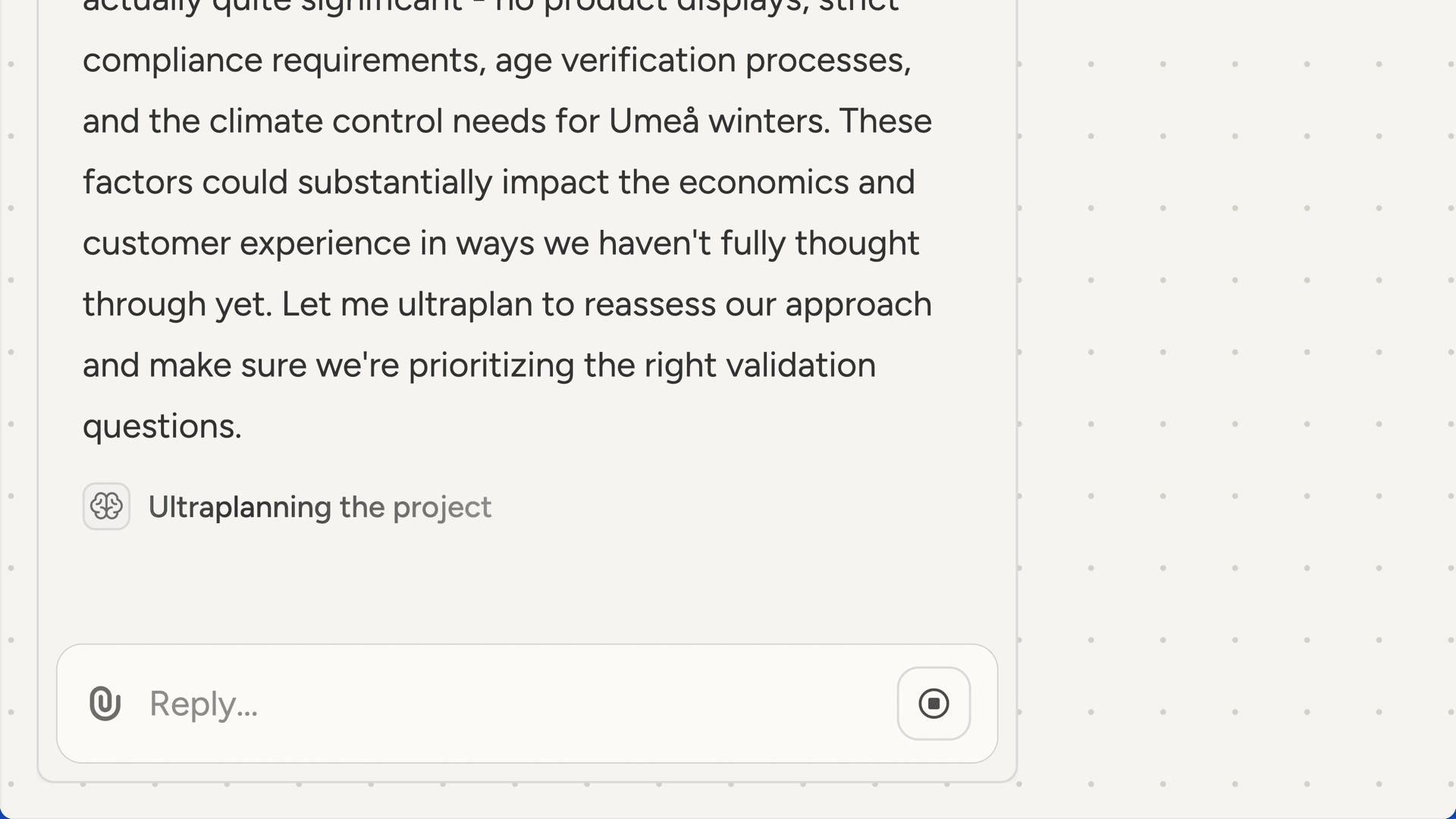
The plan document
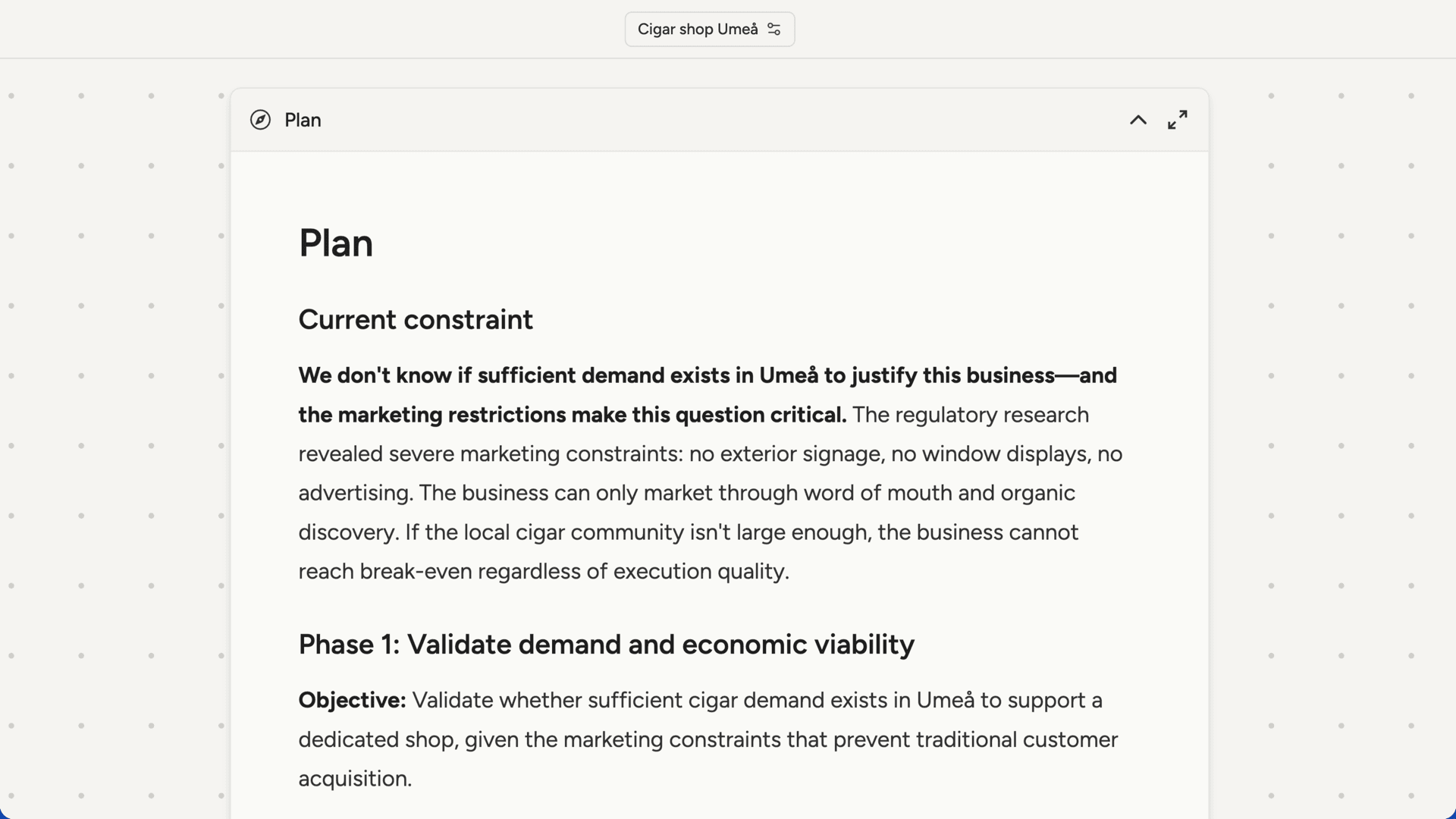
The output of ultraplanning becomes the plan document on your canvas. This is a living document that serves as your project’s roadmap. It contains:- The identified constraint and why it matters
- The current phase objective and completion criteria
- Tasks with checkboxes that you and your AI cofounder work through together
- High-level sketches of future phases
A collaborative process
Ultraplan produces recommendations, not mandates. After ultraplanning completes, your AI cofounder walks you through the results: what constraint was identified, the proposed phase, and the specific tasks. You discuss it, add context the AI might not have, and agree on the plan before anything is committed to the plan document.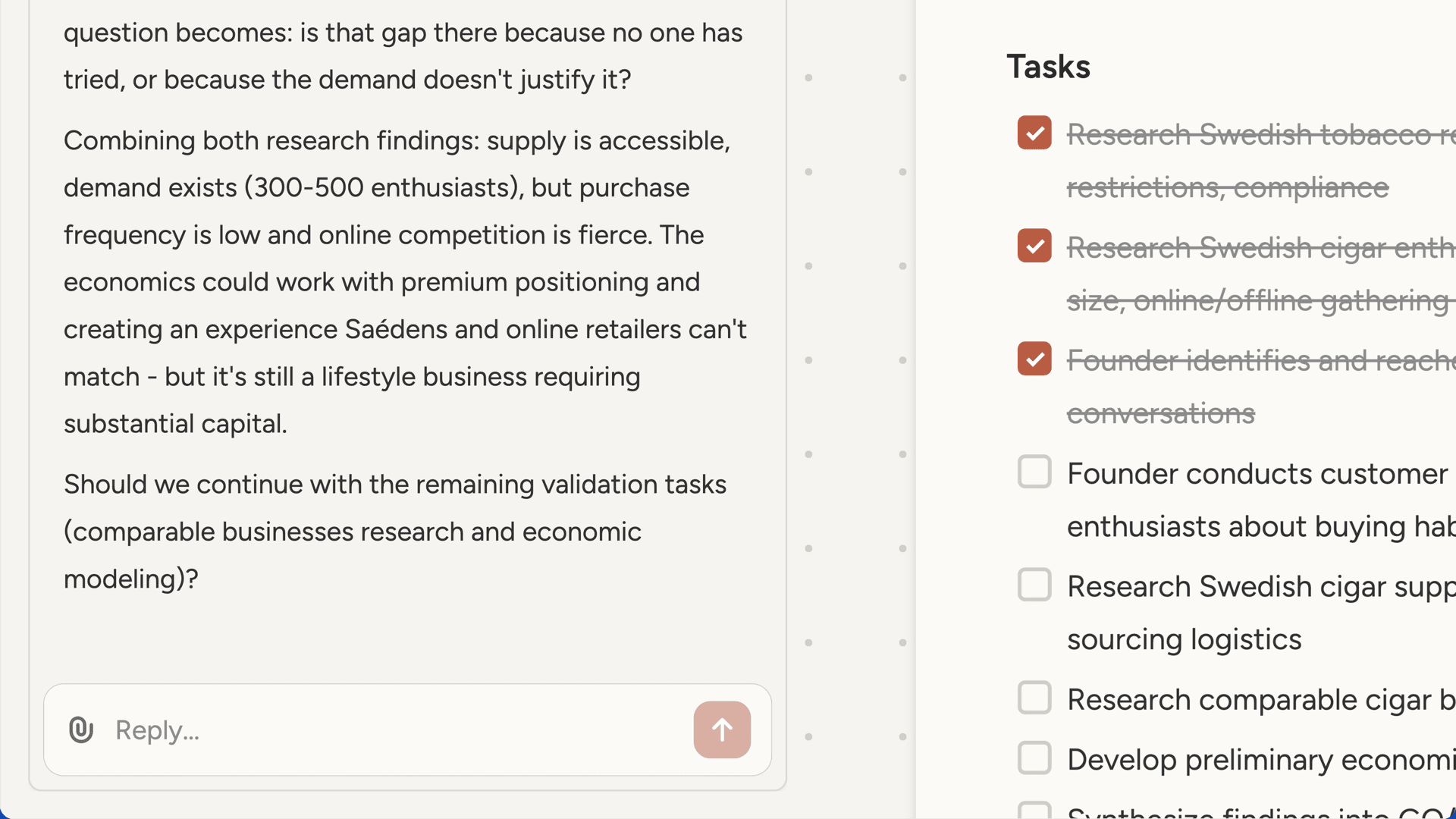
When ultraplanning happens
Ultraplan runs at natural inflection points in your project:- New projects. After your AI cofounder gathers initial context about what you’re building and who it’s for, it ultraplans to create the first phase.
- Phase completion. When all tasks in the current phase are done or the completion criteria are met, ultraplan reassesses with fresh eyes. The constraint has likely shifted.
- After research. When research produces findings that change the picture, ultraplan incorporates the new information.
- When things change. New information, a pivot, an unexpected blocker. Anything that might shift the constraint is a reason to replan.